Hormones are suicide prevention
because I missed National Suicide Prevention Month in September

[CW: suicidal ideation, discussion of the dismantling of trans rights and access to healthcare]
How bleak is it that it wasn’t the dismal reality of trans lives in the UK, but the tantalising glimpse of what a better world could look like that broke me?
That’s what made me cry at London Trans Pride. Aside from the heat, the autistic overwhelm, and my girlfriend and I struggling to communicate because we were both overstimulated and unable to meet each other's needs as well as our own, of course. Before any of that, it was the chant: what do we want? HRT; over the counter and for free.
I tried to join in with voices shouting around me, but instead choked on the words. They became a lump in my throat as a wave of sadness crashed over me. No; grief. The words pointed to the possibility of a world that is heart-wrenchingly from our own. And that possibility was so beautiful – the idea that we could one day live in that world so overwhelming – that it felt like walking into a wall. My eyes stung. I found my girlfriend's hand and squeezed tightly.
In 2026, the idea of a healthcare system that centres the dignity and autonomy of trans people feels impossible. It feels almost dangerous to imagine a society where I could walk into a pharmacy and pick up a vial of testosterone as easily as I can pick up paracetamol – because once you let yourself imagine that, the cruelty of our current systems cut deeper.
Trying to access trans healthcare in the UK feels like a full time job. There is the waiting, the following up, the educating your GP about their ability to give you a bridging prescription even before your first gender clinic appointment – because, let’s face it, you’ll be waiting years until that happens. There is the constant self-advocacy; the shame of having language that fits into a cis understanding of your body and gender used to describe you; the debilitating fear that if you say the wrong thing, they will immediately stop your access to the care that is keeping you alive.
How much energy have I spent over the last four and a half years worrying about being forced off testosterone, because even a prescription from a gender clinic didn’t make my access feel less precarious? How long did I spend worrying in the months when I couldn’t get hold of anyone at my gender clinic, when they had paused all surgery referrals for patients without telling any of us? In all that pain and sweat and tears, I didn’t have anything left in me to imagine how a different system might look.
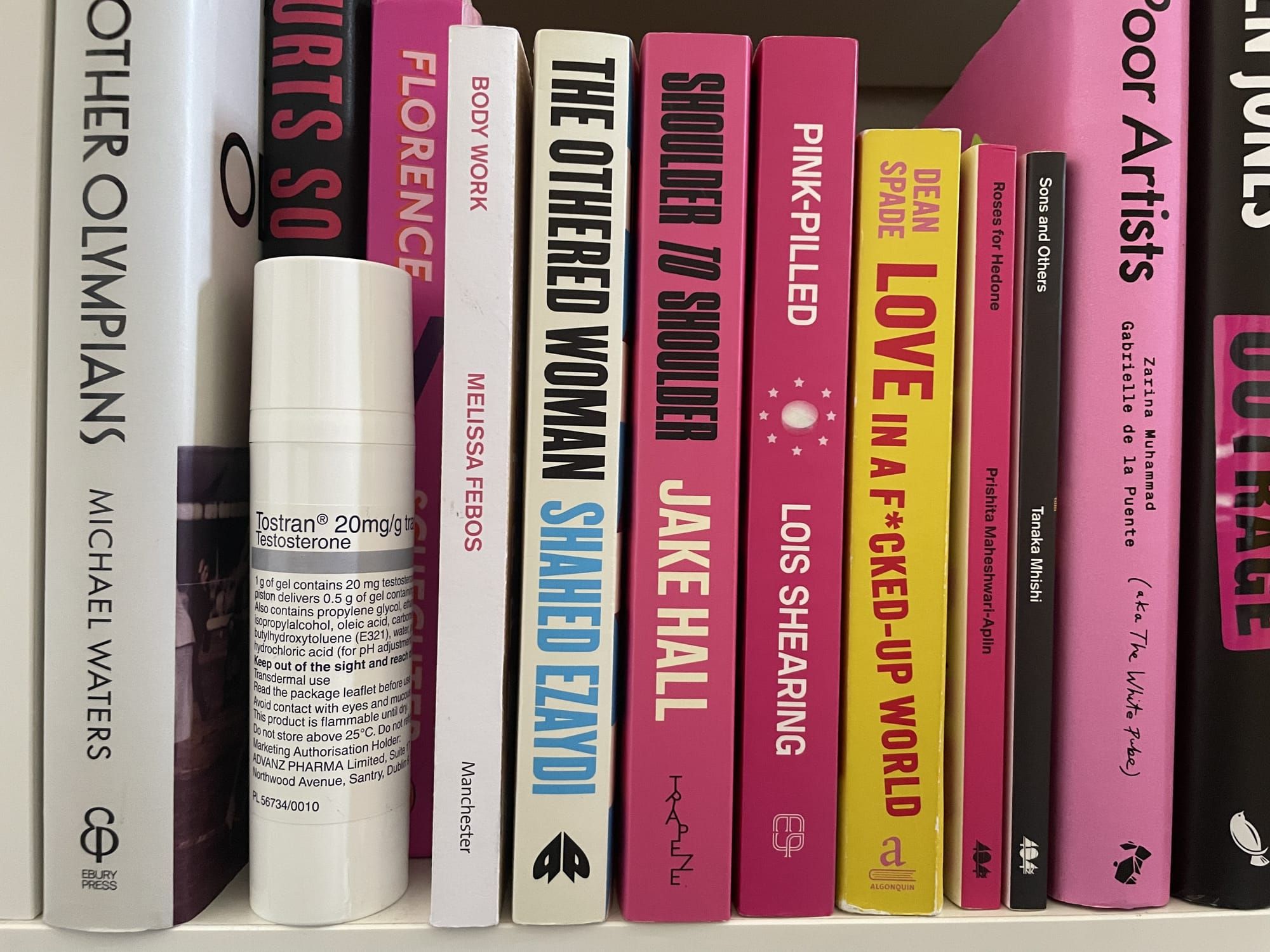
When I say ‘hormones are suicide prevention’, I don’t mean that if I didn’t get my testosterone shot every ten weeks as prescribed I will kill myself. It’s not the hormones themselves that are keeping me alive, exactly – though my suicidal ideation did skyrocket during the eleven days between when I should have got my testosterone shot in September and when I actually did. There are effects from the fluctuating hormone levels, of course, but (for me) they're secondary to the psychological effects: it’s the denial of agency and autonomy over my own body, and the way cis people get to dictate the hoops I have to jump though to access treatment that has made my life worth living that makes me want to kill myself.
Testosterone is a promise to myself – or maybe a prayer. It’s the belief that I can be the person I want to be, that I can build the life (and, yes, the body) I want. It didn’t fix my suicidal ideation, but it was a huge step towards where I am today: knowing that however loudly the intrusive thoughts in my head tell me that I want to die, I know that I want to live.
I’ve been struggling with suicidal ideation for over ten years now, and while I’ve learned how to manage it and ask for the support I need, the mainstream understanding of suicide feels pretty far behind. I agree that we need to check in on our friends, but the message that it’s ok to not be ok coupled with a link to the Samaritan's phoneline hits increasingly more hollow. (Especially when the UK Government's policies concerning disabled people suggest that those in power don't actually believe it's ok.)
You know what we need to talk about more when we talk about suicide? Access to healthcare, to housing. Financial stability and a safety net. Because these things are suicide prevention just as much as a phone number to call is. But those things necessitate questioning the systems of late-stage capitalism; it’s easier to put the onus on the person who is suicidal.
Similarly, it is possible to be so overwhelmed by navigating the healthcare system as a trans person that you forget that it doesn’t have to be like this. The humiliating, dehumanising hoops we're forced to jump through aren't, in fact, medically necessary – or even NHS policy, but based on the whims or comfort of the doctor we're seeing. And, of course, your local health board can just decide that it’s going to cancel the surgery you've waited years for when you've already gone through the pre-operative checks at the hospital.
There is nothing dictating our current system but cis people who are determined to exercise control over our bodies to uphold a colonial idea of gender binary that doesn’t exist. It shouldn’t be this way, but there is power in being able to imagine a better system – a better world.
What do we want? HRT; over the counter and for free.

Thank you for being here! You can subscribe for free below to get essays delivered directly to your inbox, and subscriber-only cruising the internet round-ups. By becoming a paid subscriber, you can help keep my writing about gender and masculinity free and accessible for everyone.